
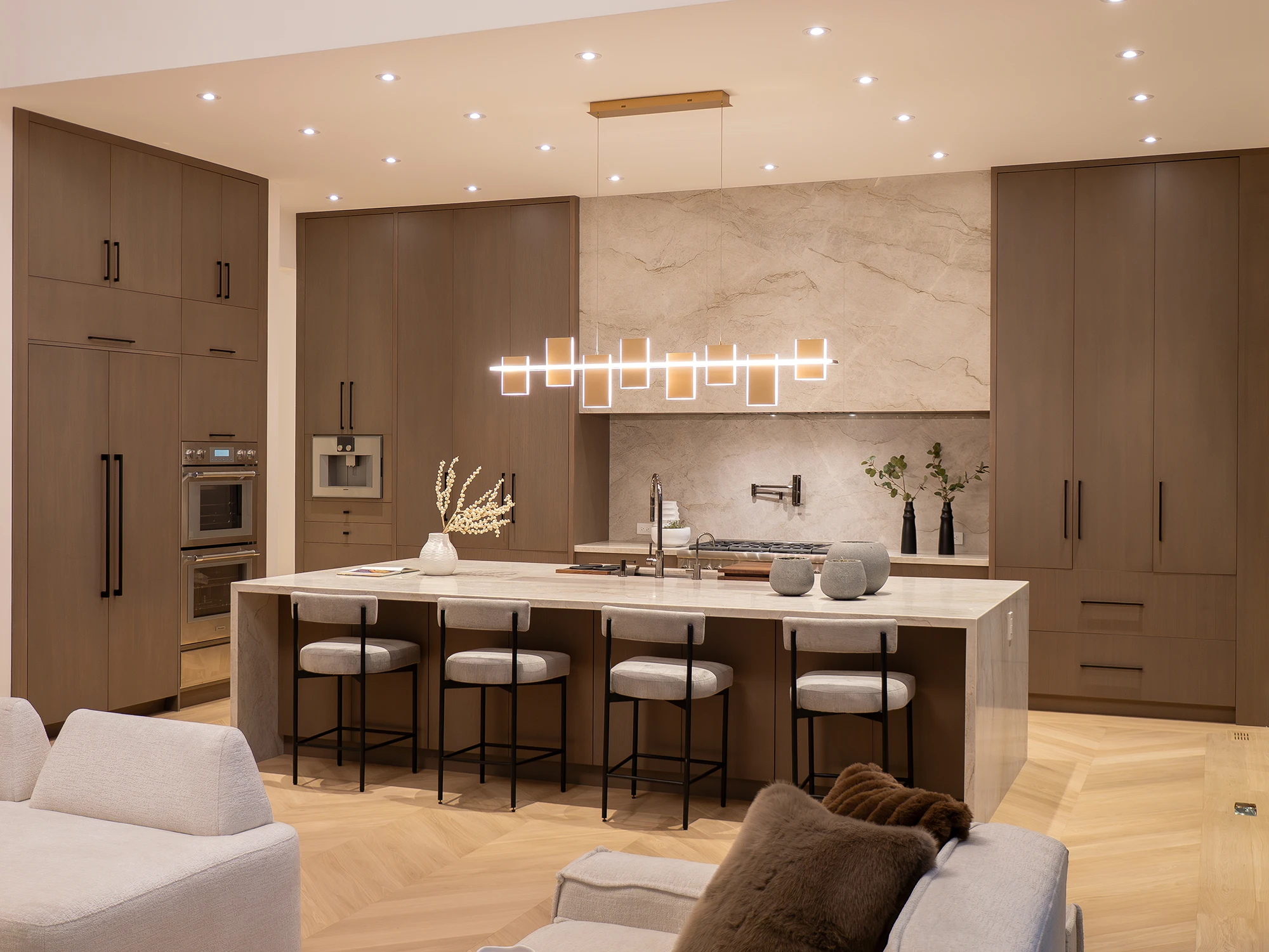
You don’t need a celebrity designer. You don’t need someone with a TV show. You need someone who reads drawings, signs the permit, and shows up on site when the plumber has a question. The word “best” gets thrown around a lot in this industry, and it can mean very different things depending on who’s saying it.
This guide breaks down what “best” actually looks like in Mississauga, Oakville, and across the GTA — the credentials that matter, the questions to ask, and the red flags worth walking away from.
“Best” in Ontario means licensed
Ontario regulates interior designers more strictly than most provinces. The credential to look for is BCIN — Building Code Identification Number — issued by the Ministry of Municipal Affairs and Housing. A designer with BCIN has passed the Ontario exams for House, Small Building, or Large Building (depending on scope) and can legally sign off on permit drawings.
If your renovation involves moving a load-bearing wall, building an addition, or changing the building envelope, you need BCIN drawings. Without that signature, the City of Mississauga, Oakville, or Burlington won’t issue a permit. Period.
When you’re vetting a designer, ask for the BCIN number directly. It’s a public registry — you can verify it yourself at the Ontario government website.
Studio Kimi: Kookdo Kim holds BCIN 106819. The firm holds BCIN 201517.
NCIDQ — the international standard
NCIDQ (National Council for Interior Design Qualification) is the gold-standard certification for interior designers across North America. It’s a three-part exam covering professional practice, contract documents, and design application. It’s the same certification U.S. designers use to advertise themselves as Certified Interior Designers.
NCIDQ doesn’t replace BCIN — they answer different questions. BCIN tells you the designer can sign permits in Ontario. NCIDQ tells you they have a measured, exam-tested understanding of the full profession: codes, ethics, materials, project management.
If a designer is going to lead your project from concept through completion, NCIDQ is the credential that says they’re held to a published standard, not just experience.
ARIDO membership — what it signals
ARIDO (Association of Registered Interior Designers of Ontario) is the provincial body. Registered Members can use the “Interior Designer” title under provincial regulation. Membership signals an active, accountable presence in the Ontario design community — not just a one-off project completer.
For a firm, ARIDO is also a network — meaning the designer is connected to other ARIDO designers, code authorities, and continuing-education channels. That matters when your project hits something unusual.
Look at finished projects — not renders
Renders are easy — especially with AI these days. Anyone can make a beautiful render. Photographs of finished, lived-in spaces are harder, and they’re what you should be looking at.
Ask to see:
- Photos of completed projects in the same category as yours (kitchen, bath, whole-home, addition)
- Photos from at least 6 months after completion — that tells you the design held up under real use
- A project from this year or last — the design industry moves fast; an inspiring portfolio from 2018 doesn’t necessarily mean 2026 capability
If a designer can only show renders, that’s a warning. It usually means the projects haven’t finished, the photos aren’t usable, or the work didn’t go to plan. Any of those is a reason to ask more questions before signing.
Studio Kimi’s recent finished work: Mona (custom home, Port Credit, Mississauga), Duncan (whole-home, Oakville), Glengarry (bathroom and ensuite, Mississauga), Erin Mills, Orleans, Maple Grove. All photographed, dated, and on the website.
The first conversation tells you a lot
The first 30 minutes with a designer should be about you, not them.
A good designer asks:
- How long has this space been bothering you?
- Walk me through a typical day in this house — where does the friction show up?
- If nothing changed about this space in the next five years, what does that mean for you and your family?
- What does the right outcome look like — not the design, the feeling?
- What’s pulling you to start now, instead of six months ago or six months from now?
If the first conversation is mostly the designer talking about their portfolio, or rushing to a price, slow down. The discovery is the foundation of the design. If it’s rushed or skipped, everything downstream wobbles.
Budget honesty over budget lowballing
The cheapest quote on a renovation almost never delivers the cheapest project. The number that lands the contract becomes the number that triggers change-orders, surprises, and arguments six months later.
The right approach in 2026:
- Establish a realistic working budget range based on scope and finish level
- Confirm the designer’s fee structure separately from construction cost
- Get a written breakdown of what’s included in the fee (drawings, FF&E, permits, project management) and what’s billed separately
- Walk through a contingency conversation — every renovation has surprises; how are they handled?
If a designer can’t talk specifically about budget at the proposal stage, the proposal isn’t a proposal. It’s a brochure.
Permits, drawings, and a real schedule
Three deliverables tell you whether a designer runs real projects or hands you off to your contractor:
- Permit drawings. Stamped or signed by a BCIN holder. The City won’t move without them.
- A coordinated drawing set. Not just floor plans — millwork elevations, plumbing locations, electrical layouts, finish schedules. Everything the trades need, in one set, with a revision log.
- A construction schedule. Phased, with key milestones. Demo, rough-ins, drywall, finish, install, deficiency walk. Not a vague “four to six months.”
If a designer doesn’t talk about these three things, the project’s going to feel improvised. Ask, specifically: “What drawings will I get, and on what schedule?” See how Studio Kimi handles design-build for a working example.
Five questions to ask in a discovery call
Bring these to every consultation. Compare the answers across designers.
- What’s your BCIN number, and what BCIN category do you hold?
- What’s an honest budget range for a project like mine, including your fees?
- Who manages the build — you, a separate contractor, or a coordinated design-build team?
- What does your drawing package include, and how many revisions are built in?
- Can I see two completed projects of similar scope from the last 18 months?
The quality of the answer matters more than the answer itself. A designer who answers clearly, with specifics, is the one who runs clear, specific projects.
What “great” looks like in Mississauga and Oakville right now
The Mississauga and Oakville market in 2026 is competitive. Custom homes are being built faster than ever. Whole-home renovations are common. Boutique commercial and hospitality projects are growing.
The firms that stand out share a few traits:
- One team, one process. Design, drawings, and build are coordinated — not handed off across three vendors.
- Honest pricing. Realistic numbers from day one. No moving targets.
- Project-led, not style-led. The design serves the family or the business, not a fixed aesthetic.
- Documented work. Real photos. Real timelines. Real client relationships.
- Local accountability. Based in the GTA, present on site, available when issues arise.
Studio Kimi works to all five of these. So do a handful of other firms in the area, and you’ll know within one meeting which ones do and which ones don’t.
Practical next step
If you’re starting a project in Mississauga, Oakville, Burlington, or the wider GTA, line up two or three discovery calls. Use the five questions above. Compare what you hear.
When you find a designer whose answers are clear, whose work is documented, and whose first conversation was about you and not them — that’s the one to keep talking to.
Studio Kimi offers a free 30-minute discovery call for new projects.
Email: hello@studiokimi.com
Phone: (289) 670-3231