


Have you ever walked into a room and immediately felt at peace? Or stepped into a space that made you feel energised and inspired? That’s because of a well-executed interior design.
Whether you’re renovating your home, decorating a new apartment, or simply looking to refresh your space, these fundamental elements and principles of interior design can help you turn any room from ordinary to extraordinary.
Interior design goes far beyond simply choosing attractive furniture and paint colours. It’s a sophisticated blend of art and science that considers how people interact with spaces, how visual elements affect mood and perception, and how functionality meets aesthetic appeal.
Studio Kimi has these elements simplified for you. So, let’s check it out!
What Makes Interior Design Actually Work?
Before we dive into the specifics, here’s something important to understand:
- The principles of interior design are guidelines used to create visually appealing spaces. At the same time, the elements are the physical tools or building blocks used when following these principles.
Think of it like cooking, the ingredients are your elements, and the recipe is your principles. Both work together to create something amazing.
The primary purpose of these principles is to support the design of rooms and homes that don’t just look great, but also serve their intended function by balancing form and function. A beautiful room that doesn’t work for your lifestyle isn’t really beautiful at all.
The Seven Essential Elements of Interior Design
1. Space – The Foundation of Everything
Space is the foundation of interior design and serves as the cornerstone on which any internal structure plan depends. Before you buy a single piece of furniture or pick out paint colours, you need to understand your space.
Space breaks down into two categories:
Positive space is the area occupied by furniture, decor, and other objects. Negative space is the empty areas that give your room breathing room and prevent it from feeling cluttered.
Here’s the thing most people get wrong – they try to fill every corner. The best designers know that finding the right balance between positive and negative space means not making it too crowded or too sparse. That breathing room is what makes a space feel luxurious and intentional rather than cramped and chaotic.
Before buying furniture, measure the room and use painter’s tape on the floor to visualise the size of the pieces.
A massive sectional in a tiny living room will overwhelm the space, while a small rug in a huge living room will feel lost, disrupting the visual harmony.
2. Line – The Silent Guide
Lines are everywhere in your home, even when you don’t consciously notice them. Lines, whether in architectural features, patterns on the floor, or lines on the ceiling, can effectively guide the viewer’s focus to key areas or features within a space.
There are three types of lines that shape your space:
- Horizontal lines create a sense of stability and make rooms feel wider (think window sills, tables, and shelving)
- Vertical lines draw the eye upward and make ceilings feel higher (columns, tall bookcases, and floor-to-ceiling curtains work wonders here)
- Dynamic lines add energy and movement (think staircases, angular furniture, or zigzag patterns)
In a room with low ceilings, incorporating vertical elements, such as floor-to-ceiling curtains or vertical panelling, can visually elevate the space, creating an illusion of height. This simple trick can completely transform how spacious a room feels.
3. Form – Shapes That Define Your Style
Form refers to the three-dimensional shapes in your space, essentially, the silhouette of your furniture and architectural features. Is that sofa boxy and modern, or curved and traditional? Is your coffee table round or rectangular?
Forms can be geometric (sharp, angular, man-made) or organic (soft, natural, flowing). The key is creating a balanced mix. A room filled entirely with hard geometric forms can feel cold and uninviting, while too many organic shapes might lack structure.
4. Light – The Mood Maker
If we could only emphasise one element, it would be this one. Lighting is arguably the most transformative element in interior design. Brighter light can intensify emotions, while low light doesn’t remove emotions but keeps them steady.
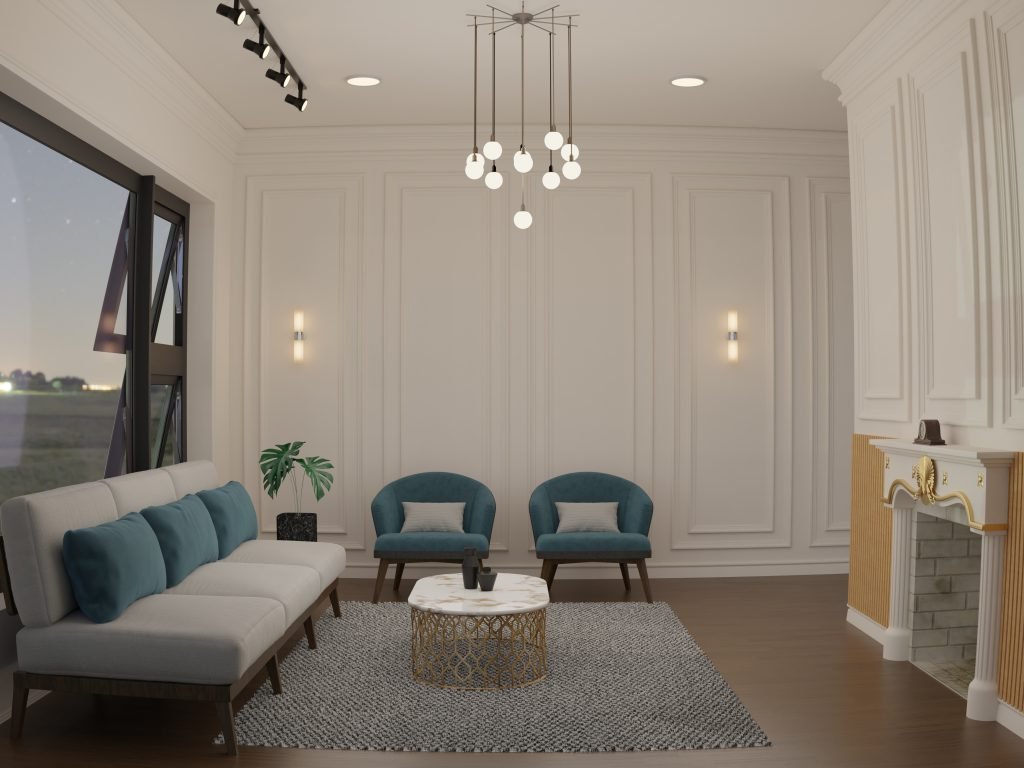
Natural light is ideal; it enhances the vibrancy of colours and creates a connection with the outdoors. But artificial lighting is where you can really get creative:
- Ambient lighting provides overall illumination
- Task lighting helps with specific activities like reading or cooking
- Accent lighting highlights architectural features or artwork
Pro tip – Layer your lighting. A room with just one overhead light will always feel flat and uninviting. Multiple light sources at different levels create depth and allow you to adjust the mood throughout the day.
5. Colour – The Emotional Powerhouse
Colour psychology is a field at the intersection of psychology and design that examines how colours influence human emotions and behaviours, and for interior designers, this understanding is pivotal.
For example, a study found that green in the workplace can increase creativity by up to 15%.
The psychological impact of colour is profound. Blue relaxes the mind and slows heart rate, metabolism, and blood pressure, making it among the most calming colours in the palette for interior design. That’s why you see it so often in bedrooms and spas.
Warm tones like red, orange, and maroon make people feel passionate or energised, while cool tones like green, blue and purple have a relaxing effect, and neutral tones like grey and white usually leave people feeling serene.
Here’s what this means for your home:
- Bedrooms – Opt for calming blues, soft greens, or neutral tones to promote relaxation
- Home offices – Choose blues or greens to enhance focus and productivity
- Dining rooms – Warm reds and oranges can stimulate appetite and conversation
- Living rooms – Earthy tones create comfort, while accent colours add personality
6. Texture – Adding Depth and Interest
Texture is the tactile quality of surfaces, such as smooth leather, rough brick, soft velvet, and cool metal. It’s what makes a space feel rich and layered rather than flat and one-dimensional.
Even if you can’t physically touch something, visual texture matters too. A chunky knit throw, weathered wood furniture, or a glossy lacquered cabinet, each adds a different sensory experience to your room.
The secret? Mix textures intentionally. Pair smooth with rough, soft with hard, matte with glossy. This contrast creates visual interest and makes your space feel more sophisticated.
7. Pattern – Visual Rhythm and Energy
Patterns introduce repeating designs that add personality and movement to a space. When incorporating patterns into interior design, it’s essential to choose complementary patterns that don’t compete for attention, ensuring a balanced aesthetic.
Here’s a foolproof formula – combine one large-scale pattern, one medium-scale pattern, and one small-scale pattern, all sharing a common colour palette. This creates cohesion without monotony.
The Seven Principles – Putting It All Together
Understanding elements is one thing, but knowing how to combine them is another. That’s where the principles come in.
1. Balance – Creating Visual Equilibrium
Balance creates a sense of harmony as it pertains to the visual arrangement of furniture and decor that distributes objects evenly to achieve equilibrium within the room, ensuring no single element dominates in terms of visual weight.
There are three types:
Symmetrical balance is formal and calming. Imagine matching nightstands flanking a bed or identical chairs on either side of a fireplace. It’s traditional and creates immediate visual stability.
Asymmetrical balance is more dynamic and interesting. It involves arranging different elements to achieve balance without mirroring each other, creating a more visually interesting space often seen in modern and eclectic designs. You might balance a large sofa on one side with two smaller chairs on the other.
Radial balance arranges elements around a central focal point, like dining chairs around a circular table or furniture arranged around a stunning chandelier.
2. Harmony and Unity – The Thread That Connects
Harmony involves arranging objects and colours in a space to create a unified and cohesive aesthetic, achieved when everything in a room works together to reinforce a common theme or style.
Think of harmony as the thread that runs through your entire home. It’s accomplished by carefully choosing and repeating certain design elements, such as the use of patterns that echo one another in various spaces, whether through upholstery fabrics, rugs, or artwork.
This doesn’t mean every room should look identical. Instead, create consistency through repeated elements, maybe it’s a colour palette, a material like brass hardware, or a design style that appears throughout.
3. Rhythm – Creating Visual Flow
Rhythm refers to repeating design elements like patterns, textures, colours, and shapes that create a sense of movement and flow. It’s what makes your eye travel naturally through a space rather than getting stuck in one spot.
Repetition strengthens the design by echoing elements throughout the space, and movement is the path the eye follows around a room, orchestrated by strategically placing attention-grabbing elements that lead the viewer from one area to another.
Imagine a living room with a blue and white striped rug. The rhythm begins there, continues with blue throw pillows on the sofa, flows to blue pottery on the bookshelf, and completes with blue artwork on the wall. Your eye naturally follows this visual journey.
4. Proportion and Scale – Getting the Size Right
Proportion refers to the relationship between two items, while scale concerns how one object’s size relates to another. This is where a lot of DIYers go wrong.
A tiny coffee table in front of an oversized sectional looks awkward. A massive dining table in a small room overwhelms the space. Your furniture should be appropriately sized for both the room and for each other.
A helpful rule – artwork above a sofa should be roughly two-thirds the width of the sofa. Side tables should be about the same height as the arm of your chair or sofa. These proportional relationships create visual harmony.
5. Emphasis – Creating a Focal Point
Emphasis in interior design is about creating a focal point that draws attention immediately upon entering the room, which can be established through various elements such as a unique piece of artwork, striking furniture, or an architectural feature like a fireplace.
Every room needs a star, something that captures attention and anchors the design. Without emphasis properly executed, it not only adds visual interest but also helps to anchor the design.
This could be a statement chandelier, a stunning piece of art, an architectural feature like a brick fireplace, or even a bold accent wall. Once you’ve identified your focal point, arrange other elements to support rather than compete with it.
6. Contrast – Adding Drama and Interest
Contrast is an important design element because it adds depth, visual interest, and a sense of balance to your room, ensuring your design is dynamic and engaging through pairing bold colours, mixing textures, or combining different shapes and sizes.
Without contrast, spaces feel flat. It’s the difference between an all-beige room (monotonous) and a beige room with black accents, varied textures, and pops of greenery (sophisticated and layered).
Contrast can be subtle, matte against glossy, rough against smooth, or dramatic, like dark furniture against light walls.
7. Details – The Finishing Touches
The devil’s in the details, as they say. It’s the carefully chosen throw pillows, the hardware on your cabinets, the trim on your curtains; these small elements tie everything together and add personality to your space.
Key Takeaways for Your Design Journey
Let’s bring this all together with practical advice you can use right now:
- Start with space planning. Understand your positive and negative space before buying anything. Measure twice, purchase once.
- Use colour psychology strategically. Colour psychology in interior design is an important factor to consider when starting a new project, with answers to who will be interacting with your space and what emotions you hope they will feel, helping guide your use of colour.
- Layer your lighting. Never rely on just overhead lights. Add table lamps, floor lamps, and accent lighting for a professional look.
- Create a focal point in every room. Give the eye somewhere to land, then build around it.
- Mix textures and patterns intentionally. This creates depth and keeps spaces from feeling flat.
- Maintain balance and harmony. Whether symmetrical or asymmetrical, your space should feel visually stable.
- Pay attention to proportion. Make sure your furniture fits both the room and itself.
Transform Your Space with Professional Expertise
Understanding these design principles is just the beginning. While this knowledge empowers you to make informed decisions about your space, bringing together all seven elements and principles requires expertise, experience, and a trained eye for detail.
Studio Kimi specialises in creating harmonious, functional environments that perfectly balance aesthetics with livability.
Whether you’re planning a complete home renovation or looking to refresh a single room, Studio Kimi’s expert team can help you navigate colour choices, spatial planning, and design principles to create spaces that truly reflect your lifestyle and personality.
Bringing It Home
Interior design is about understanding these fundamental elements and principles, then using them to create spaces that work for your life and reflect your personality.
These design principles transcend individual disciplines and find relevance in everything from architecture to fashion. Still in interior design, their application must balance aesthetic appeal with practicality, creating environments that are not only beautiful but also livable.
Even professional designers don’t use all elements and principles equally in every project. They’re tools in your toolkit; use the ones that serve your specific space and goals.
Maybe your small apartment needs more focus on space and light, while your spacious home can play with bolder patterns and dramatic focal points.
Let Studio Kimi Bring Your Vision to Life
While understanding design fundamentals is valuable, executing them flawlessly requires professional expertise. Studio Kimi offers comprehensive interior design services that take the guesswork out of creating beautiful, functional spaces.
From initial consultation to final installation, their team handles every detail, spatial planning, colour selection, furniture sourcing, lighting design, and custom solutions tailored to your unique needs.
Contact Studio Kimi today to schedule a consultation and discover how expert interior design can transform your house into the home of your dreams. With a portfolio of stunning projects and a commitment to client satisfaction, Studio Kimi turns design principles into lived reality.
What will you design first?


