

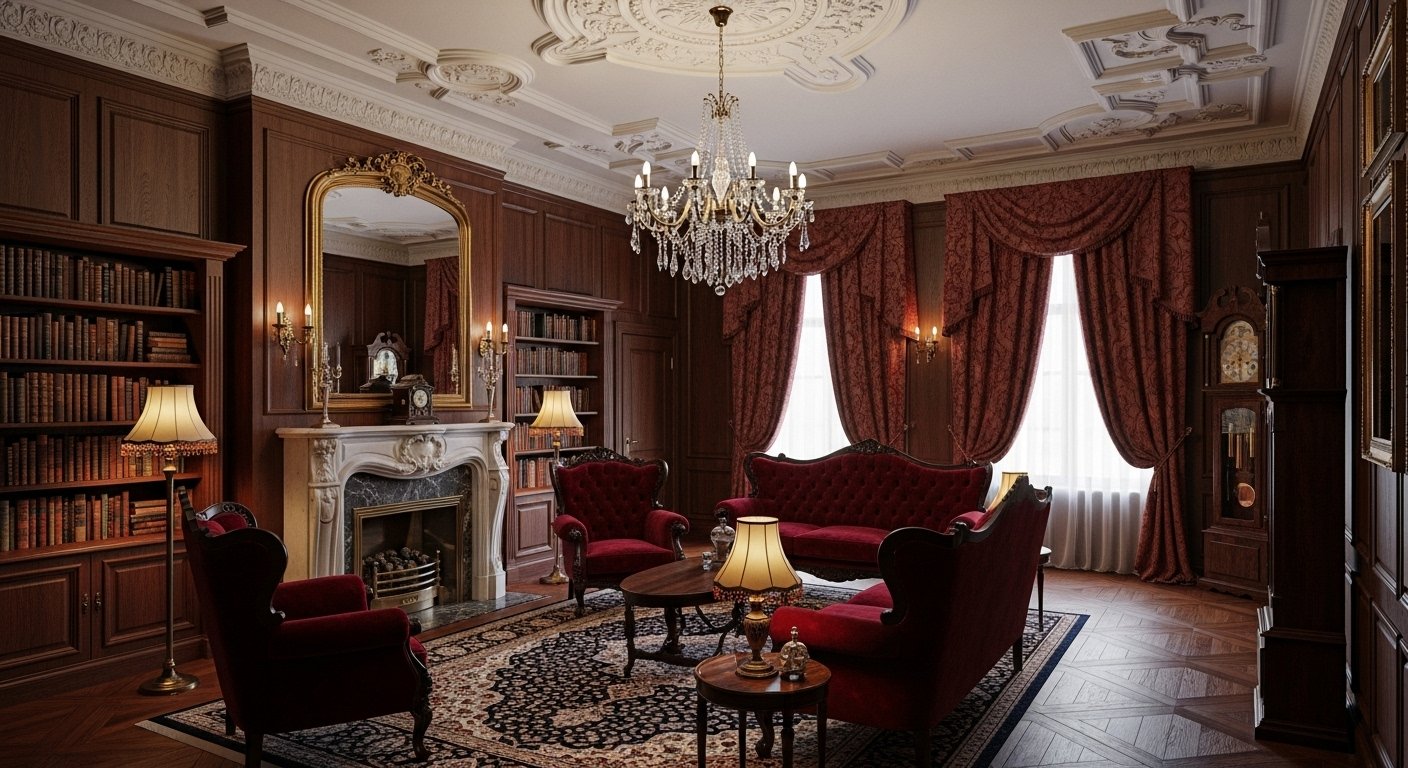
The chair you’re sitting in? It wasn’t designed for comfort; it was a political statement. It sounds dramatic, right? Now, close your eyes for a moment. Now open them and look around your space. See that minimalist coffee table? Thanks to the Bauhaus movement from 1920s Germany. That cosy throw pillow? Ancient Egyptians invented decorative textiles 5,000 years ago. Your smart lighting system? It’s the great-great-grandchild of Roman oil lamp innovation.
But every single item in your home, from the simple lines of your coffee table to the colour on your walls, carries a hidden history. It’s a story of power struggles, social revolutions, and even ancient public health scares. Hear the interior design history and evolution from Studio Kimi, your design experts.
3000BC-400AD! When Death Required Better Design Than Life
Imagine designing a space that you will only use after you die. That’s how much the stakes were raised in the ancient world.
Egyptians Designing for Eternity
The Surprise! Ancient Egyptian interiors weren’t truly designed for living. They were elaborate, vibrant hotel rooms for the soul.
Ancient Egyptians were the first civilisation to hire professional interior designers. The twist? They weren’t decorating living rooms, they were designing dying rooms.
King Tutankhamun’s tomb contained over 5,000 objects when archaeologists discovered it in 1922. Solid gold furniture, intricate wall paintings, decorative oils, and ceremonial beds filled the space. Research published in the Journal of Ancient Egyptian Architecture indicates that a pharaoh’s tomb received approximately 100 times more design investment than their actual palace.
This was excessive but was strategic. Egyptians believed the afterlife lasted forever, while earthly life was temporary. Investment priorities reflected that belief.
Egyptian innovations still used today:
- Colour psychology (red for power, blue for divinity, gold for immortality)
- Layered textiles and decorative pillows
- Strategic lighting placement for ambience
- Custom-built statement furniture
The Key Characteristics of Egyptian Interior Design
The Egyptians pioneered the concept of furniture as art. Their beds, chairs, and chests were often carved into animal shapes or adorned with hieroglyphs, making them religious artefacts as much as functional items.
A key detail you can see in your own home – the low-slung stool or simple chair. It is a direct descendant of the low Egyptian stool. Why low? It was a simple, yet practical design choice that kept the body off the sacred, dusty ground, protecting the user from pests and dirt. Functionality, driven by ritual, influenced the first piece of furniture you see.
A UCL research paper highlights that ancient Egyptian burials are renowned for their opulence, demonstrating efforts to ensure the dead’s survival in the afterlife and serving as significant evidence of their beliefs.
Greek Philosophy Meets Design
The Greeks revolutionised design by introducing a radical concept – beauty could be calculated, measured, and replicated through mathematics.
The Golden Ratio (1:1.618) that contemporary designers obsess over? Greek mathematicians developed it around 500 BC. They believed perfection came through proportion and geometry, not decoration.
The real innovation was democratisation. Before the Greeks, beautiful interiors were exclusively for the ultra-wealthy. Greek culture changed that paradigm. Public spaces, temples, theatres, and gathering places received the same design attention as private homes.
Greek contributions to modern design:
- Symmetrical room layouts
- Geometric patterns in textiles and tiles
- The concept that beauty requires balance
- Public spaces as community design projects
Roman Engineering For Maximalism And Innovation
The Surprise! The ultimate Roman dining room, the triclinium, was not built for sitting upright. It was essentially a semi-reclined, low-table feast hall.
Romans inherited Greek design principles and supercharged them with technological innovation. If Greeks were minimalist architects, Romans were maximalist engineers.
The concrete revolution changed everything. Roman concrete (perfected around 200 BC) allowed for larger interior spaces without support columns, curved walls, domed ceilings, heated floors, and indoor plumbing.
One of our interior design experts at Studio Kimi states that,
Roman concrete technology changed building construction and shaped how humans conceptualised interior space.
Roman mosaics exemplified their design ambition. The famous Alexander Mosaic from Pompeii contains approximately 1.5 million individual tiles, requiring an estimated 2-3 years to complete with modern tools.
The Key Characteristics of Greek And Roman Interior Design
The Romans built their design around the ritual of socialising and consumption. Guests would recline on couches on three sides of a low central table, perfect for long, relaxed gatherings, the first form of “binge-watching” in a social context!
Their villas even featured the hypocaust, an early form of central heating that used underfloor cavities to circulate hot air, adding unparalleled comfort. This lavishness was a reaction to the Greeks, who championed the simple life. Greek interior design emphasised balance, proportion, and symmetry, a disciplined, intellectual approach often found in their temples and public buildings.
In contrast, the Romans expanded on this, introducing showy Roman excess, lavish materials like marble, intricate mosaics, and decorative water features indoors.
400-1600AD! Medieval to Renaissance
After the Roman Empire faded, grand architectural projects largely paused. Interior design during this period was defined less by permanent aesthetics and more by survival, mobility, and religious devotion.
Medieval Contrast in Fortress Exteriors, Palace Interiors
Medieval castles presented cognitive dissonance. From outside – grim, grey, imposing fortresses. Inside – explosions of colour, tapestries, gilding, and artistic celebration.
The Surprise! Those magnificent tapestries you see in movies were essential, removable, portable wall insulation.
This was strategically designed for dangerous times.
Medieval tapestries solved five problems simultaneously:
- Insulation (stone castles were freezing)
- Decoration (artistic displays)
- Status symbols (good tapestries cost more than houses)
- Storytelling (visual narratives for illiterate populations)
- Portability (wealthy families travelled between estates).
Textile historian Dr Elizabeth Cleland at the Metropolitan Museum of Art notes –
A single large tapestry could take four weavers two years to complete and cost the equivalent of a soldier’s 20-year salary.
When the lord moved to another manor, the tapestry was rolled up and taken along, proving their wealth wherever they went.
Permanent, bright ornamentation was often reserved for churches, which were the most stable and enduring structures of the time. In the home, design revolved around movable pieces – screens to block the hearth smoke, simple wooden furniture, and chests for storage.
Colour inside a medieval home was an incredibly expensive design element before synthetic dyes; achieving true reds, blues, or golds required rare pigments or expensive imported cloth. If a peasant’s home was plain wood, it was because of simple economics, not minimalist taste. The vibrancy we see in illuminated manuscripts speaks volumes about the value placed on even a small patch of deep colour.
Gothic Drama Where Architecture Represents Certain Psychologies
The Gothic period (roughly 1200-1500 AD) created “architectural theatre” where every design choice served dual purposes – functional and psychological.

Research from architectural psychologists shows that high ceilings literally change how humans think, promoting abstract thinking and spiritual contemplation. Gothic churches were designed to manipulate human emotion and cognition through vertical emphasis, light manipulation via stained glass, acoustic design, and spatial progression from dark entrances to illuminated altars.
Modern theme parks use these exact techniques. Disney Imagineers study Gothic cathedral design when creating immersive experiences.
Renaissance Revolution For Personal Expression Emerges
The Renaissance (roughly 1400-1600 AD) introduced a radical idea – home interiors should reflect individual personality.
The Surprise! The Renaissance wasn’t just about painting and sculpture; it was about architects taking total control, designing the building, the frescos, the lighting fixtures, and even the silverware. This is where the concept of the integrated professional is born.
Before the Renaissance, interiors followed rigid conventions. After, personal expression became not just acceptable but expected. For the first time, wealthy merchants (not just nobility) could commission custom furniture, choose colour schemes, and hire artisans to create personalised spaces.
Leonardo da Vinci designed furniture and interior layouts. Michelangelo consulted on room proportions. The greatest artists considered interior design equally important to their “fine art.”
We would say –
The Renaissance invented the concept of the interior designer as a skilled professional. Before this, decorating was handled by whoever built the furniture. After, it became a specialised craft requiring artistic training.
We see the rise of patronage, where hugely wealthy merchant families (like the Medicis) commissioned bespoke “total environments.” They were buying furniture while buying a lifestyle that showcased their education and power. This need for a cohesive, custom vision is the direct ancestor of the modern interior design profession.
The Era Of Extravagance and Rebellion With The Political Art
As monarchies solidified power, design became the most visible weapon in their political arsenal, leading to styles of extreme opulence and subsequent, playful rejection.
Baroque & Rococo To Design as Propaganda (The Power Flex)
The 17th and 18th centuries saw styles that were pure performance.
The Surprise! Styles like Baroque (dramatic, heavy, gold-laden) and Rococo (light, whimsical, shell-like) weren’t just random trends. In fact, they were political statements by the monarchy, designed to demonstrate absolute power and distance themselves from the common classes.

There is no better storytelling example than the Palace of Versailles. The Baroque style demanded dramatic scale, intense contrast, and overpowering ornamentation. Every curve, mirror, and piece of ornate plasterwork was precisely designed to make the visiting noble or courtier feel small and overwhelmed by the King’s God-given authority. It was pure design as propaganda.
Then came the rebellion. The Key Detail is that Rococo was the first “anti-establishment” design movement. As the style spread in France, it became a playful, sensual reaction against the heavy, formal seriousness of the Baroque court. Rococo interiors used soft pastels, shell motifs, and asymmetrical curves. It was fun and feminine, a lighthearted escape for the aristocracy, further emphasising their privileged leisure.
Victorian Era! A Design by Anxiety (Clutter and the Germ Theory)
The 19th century brought the chaos of the Industrial Revolution, fundamentally altering what people owned and how they decorated.
The Surprise! The famous Victorian clutter, the heavy drapery, and the maximalist explosion of patterns were simply poor taste and were driven by industrial-age anxiety and new wealth.
The Industrial Revolution provided new technologies (cheap wallpaper, mass-produced furniture) and gave a rapidly expanding middle class enough money to buy things. This explosion of stuff met the nascent Germ Theory scare.
People were trying to hide the cheap new world, and any potential dirt, under layers of drapery, fringe, tassels, knick-knacks, and complex, dirt-masking patterns. It was the original maximalism, and it came from a place of deep insecurity.
The Key Detail lies in the overstuffed parlour. The sheer volume of objects, from taxidermy to ceramics to framed photos, was designed to be a public demonstration of financial success. The room was often so full that it was unusable. It showed guests you had so much money, you could afford to fill the room with things you didn’t need and still have plenty left over.
1900-Present! The Modern Era Where Democracy Meets Design
The 20th century was the era where interior design stopped being about covering up flaws and started trying to fix society itself. This period produced the professionals and the philosophies that still dominate your home today.
The Birth of the Professional – Elsie de Wolfe (The First Interior Dictator)
As the Victorian era’s clutter became suffocating, the stage was set for a hero, or perhaps, a dictator.
The Surprise! The world’s first celebrity “Interior Decorator,” Elsie de Wolfe, was essentially a society gatekeeper who looked at the wealthy women of New York and told them they were doing everything wrong.
Before de Wolfe, interiors were handled by upholsterers or cabinetmakers. She was a stage actress who leveraged her social connections to make design an exclusive, high-end service for the elite. She convinced clients that their heavy, dark, cluttered Victorian homes were ugly and unhealthy.
Her antidote? Light, air, and simplicity, often using white paint and streamlined furniture. Her work was a breath of fresh air after the heavy Victorian style, initiating the professional evolution interior design desperately needed.
Her genius was in moving the practice from the hands of the upholsterer to the realm of high taste, establishing the profession that exists today.
Bauhaus and Modernism! For Function Over Decoration
The Bauhaus school in Germany (1919-1933) proposed something revolutionary: “Form follows function.” On the other hand, if Elsie de Wolfe cleaned up the elite’s homes, the Modernist movement wanted to clean up the world.
The Surprise! Modernism and the Bauhaus movement were deeply socialist-leaning movements that sought to eradicate class difference through simple, functional, affordable design.
The famous slogan, “Form Follows Function,” was a revolutionary battle cry. This simple, clean, and functional style was a direct, ideological rejection of the fussy, expensive, class-based ornamentation of the Victorian and Art Deco eras. Ornamentation, to them, was a lie. They used new industrial materials, steel, glass, and concrete, to create minimal, efficient structures that could be mass-produced.
This simple phrase transformed design forever. Every previous movement prioritised appearance. Bauhaus said utility should drive aesthetics.
Bauhaus Principles:
- Remove unnecessary decoration
- Design should be accessible to everyone
- Functionality before aesthetics
- Mass production enables democratic design
- Good design solves problems
The dark twist! Nazis shut down Bauhaus in 1933, calling it “degenerate art.” This political persecution scattered Bauhaus teachers globally, accidentally spreading the movement worldwide. Walter Gropius moved to Harvard. Ludwig Mies van der Rohe moved to Chicago. Their influence shaped American modernism entirely.
Mid-Century Modern! The Eternal Style
After World War II’s destruction, designers imagined something radically different – bright, optimistic, functional spaces for a better future.
Mid-Century Modern combined clean lines from Bauhaus, organic shapes from Scandinavian craft traditions, new materials like moulded plywood and fibreglass, indoor-outdoor connections, and bright colours.
Why Mid-Century Modern never disappeared
Most design trends enjoy 10-15 years of popularity, then vanish for decades. Mid-Century Modern has remained continuously popular for 80+ years.
The Mid-Century Modern hits the perfect balance between comfort and sophistication, simplicity and interest, traditional and modern. It photographs beautifully, which makes it perfect for the visual media age.
Plus, it’s endlessly adaptable, working equally well as minimalist, maximalist, luxurious, or budget-friendly depending on execution.

The 21st Century! Designing Smart, Sustainable, & Personalised
Today, interior design is no longer just about function or status; it’s about survival in a digital world and responsibility to the Earth.
Design as Therapy (Biophilia and Hygge)
We live in an era of unprecedented stress and screen time. Our homes have become our new battleground for peace of mind.
The Surprise – Today’s biggest movements, like Biophilic Design (bringing nature indoors) and Hygge (the Danish concept of cosiness), are not fleeting styles; they are scientific responses to a high-stress, digital world.
The biggest design battle today is against our screens. Interiors must now function as true sanctuaries, focusing on mental health, light quality, and air purification. This is where evidence-based design meets home decor, using elements like natural wood tones, large windows, and indoor plants to reduce cortisol levels.
The Instagram Effect
Instagram changed interior design more than any artistic movement in the last 50 years. Before social media, design trends spread slowly through magazines and showrooms. After Instagram, trends can explode globally in weeks. Instagram documented design trends and has been actively creating and accelerating them. A single viral post can make a specific chair style sell out globally within days.
The digital revolution’s interior impact:
- Design became performative (does it photograph well?)
- Virality drives trends
- Influencers replace traditional tastemakers
- DIY becomes legitimised through tutorials
- “Instagrammable” becomes a design requirement
Sustainability as Standard
Climate consciousness transformed from a niche concern to a design essential in roughly 10 years.
Modern sustainable design includes:
- Reclaimed and recycled materials
- Low-VOC paints and finishes
- Energy-efficient lighting
- Biophilic design (bringing nature indoors)
- Circular economy principles (designing for disassembly and reuse)
The irony! “Sustainable” products are now luxury status symbols. A $2,000 reclaimed wood table signals both values and wealth simultaneously.
Health-Conscious Interiors With Post-Pandemic Priorities
COVID-19 permanently changed interior design priorities. When homes became offices, schools, gyms, and restaurants simultaneously, design requirements exploded.
New health-focused priorities:
- Air Quality – HEPA filtration systems, plants as natural air purifiers, low-VOC materials, improved ventilation, and air quality monitors. Research from Harvard’s T.H. Chan School of Public Health shows improved air quality can increase cognitive function by up to 11%.
- Circadian Lighting – Tunable LED systems matching natural light patterns, warmer light at night and cooler during the day, with automatic adjustments. Research shows this improves sleep quality by 15-20%.
- Biophilic Design – Natural materials (wood, stone, organic textiles), living walls and indoor gardens, nature views and natural light maximisation, water features, and organic shapes.
Style Democracy Where Every Era Coexists
The current design is unprecedented – every historical style coexists simultaneously. Mid-Century Modern furniture, farmhouse decor, industrial loft aesthetics, minimalist Scandinavian, maximalist boho, and Art Deco revival, all available in the same stores, all considered equally valid.
This has never happened before. Previous eras had dominant styles. This era has style democracy, choose whatever resonates.
Patterns That Connect The Hidden Design Rules
The Pendulum Effect
Design trends swing between minimalism and maximalism roughly every 30-40 years, approximately one generation. The timeline proves the pattern:
- 1780s – Neoclassical simplicity
- 1840s – Victorian maximalism
- 1920s – Bauhaus minimalism
- 1960s – Maximalist patterns and colours
- 1990s – Minimalist neutrals
- 2020s – Maximalism returning
People rebel against their parents’ aesthetic choices. Those who grew up in cluttered Victorian homes craved clean Modernism. Those raised in stark minimalism craved colourful maximalism.
Technology as Disruptor
Every technological revolution completely transforms interior design:
- Concrete (200 BC) – Enabled new shapes, larger spaces, curved walls
- Glass windows (1600s) – Changed relationship with natural light
- Electricity (1880s) – Freed furniture placement from proximity to natural light
- Air conditioning (1920s) – Made hot climates livable year-round
- Internet (1990s) – Enabled remote work, changed home office requirements
- Smartphones (2000s) – Made homes controllable remotely, integrated smart systems
The Future Is Fluid!
We have traced the remarkable evolution of interior design from the spiritual spaces of Egypt to the functional spaces of Modernism.
- The Egyptians decorated for the dead.
- The Romans designed for socialising.
- The Monarchs were designed for power.
- The Modernists designed for equality.
Every single shift was a radical reaction against the excesses or inadequacies of the previous age. The story is clearly not finished.
Final Intrigue! What will the next great design history rebellion be? Will we see a complete, radical rejection of smart technology, or perhaps an entirely new design philosophy driven by interstellar colonisation? Whatever the future holds, your home will be the first place it takes root.
Looking Forward – What Comes Next?
Predicted Trends Based on Historical Patterns
- Climate-Responsive Design (2025-2035) – Homes will actively respond to environmental conditions through passive heating and cooling, rainwater collection, thermal mass materials, and energy generation exceeding consumption.
- Modular Spaces (2025-2040) – Urban density increases demand for furniture that easily reconfigures, walls that move or disappear, rooms serving multiple functions seamlessly, and architecture designed for disassembly and reuse.
- Virtual Reality Integration (2030-2050) – Physical spaces will blend with digital overlays—walls becoming any surface digitally, virtual art changing daily, furniture appearing/disappearing through AR, and spaces transforming completely based on activity.
The Eternal Constants
Despite all changes, humans have wanted the same things from spaces for 5,000 years:
- Safety and security
- Comfort
- Status display
- Personal identity expression
- Connection with others
- Beauty and inspiration
Key Takeaways
- Interior design reflects culture, not just aesthetics – Every style reveals deeper truths about its era’s values, fears, and aspirations.
- Technology drives design evolution – From concrete to smart homes, each technological leap transforms how spaces are conceptualised.
- The pendulum swings predictably – Minimalism and maximalism alternate every 30-40 years as generations rebel against previous aesthetics.
- Economic conditions shape trends – Wars, plagues, booms, and busts directly influence design priorities and popular styles.
- Human needs remain constant – Despite changing styles, people still seek safety, comfort, status, identity, connection, and beauty.
- The current era is unprecedented – For the first time, all historical styles coexist as equally valid choices.
- Sustainability is now standard – Climate consciousness transformed from niche to baseline expectation in design.
- Health-focused design emerged – Post-pandemic priorities permanently elevated air quality, biophilic elements, and flexible spaces.
- Social media accelerates trends – Instagram changed how quickly design movements spread and how spaces are conceptualised.
- Personal expression dominates – Modern design prioritises individual identity over conforming to a single dominant style.
Conclusion
The most surprising thing about interior design history is how much hasn’t changed yet. Humans still want comfort, beauty, identity, and connection. Each era simply finds new ways to achieve those ancient goals.
Every design choice throughout history represents someone answering fundamental questions – How should this space feel? What should it communicate? How can it serve life better? What kind of future is being designed toward?
And that revelation is surprisingly profound. If you want interior design services for your spaces, consider Studio Kimi, as we can tell your story best.


