
Materials · Studio Kimi Journal
One is quarried, one is manufactured, and the names are close enough that showrooms use them almost interchangeably. Here is the difference that actually changes how you live with the counter.
Almost every kitchen we design reaches the same fork, usually about three weeks in. The layout is settled, the millwork is drawn, and somebody asks the question that has been sitting in the background the whole time: what goes on top? Nine times out of ten the shortlist has come down to quartz and quartzite, and nine times out of ten the client is not entirely sure which one they have been looking at.
That confusion is not carelessness. The two words differ by three letters, they sit side by side in the same showrooms, and slabs of one are routinely finished to look like the other. But they are not variations of a single material. One is manufactured and one is quarried, and that single fact drives everything downstream — how the surface behaves, what it costs to fabricate, how it ages, and what you are allowed to be careless about.
Quartz is made. Quartzite is dug up.
Quartz — the countertop material, not the mineral — is engineered. Roughly nine parts crushed natural quartz to one part polymer resin and pigment, pressed and cured into a slab. Because it is made rather than found, it is non-porous, colour-consistent from slab to slab, and available in patterns that were designed rather than formed. Caesarstone, Silestone and Cambria are all quartz.
Quartzite is a natural stone. It begins as sandstone, and heat and pressure over a geological span fuse the quartz grains into something considerably harder. It is quarried, sawn into slabs, and sold as it came out of the ground. Its veining is the record of how it formed, which is why no two slabs match and why you should never buy quartzite from a photograph.
So the shorthand is: quartz gives you predictability, quartzite gives you a piece of geology. Neither of those is the right answer on its own. The right answer depends on the room and on the household.
Hardness and heat: the part people get backwards
Quartzite is harder. On the Mohs scale it sits around 7, above glass and above most steel, which is why fabricators charge more to cut it and why it shrugs off scratches that would mark a softer stone. Quartz slabs test in the same neighbourhood for scratch resistance in ordinary use, so for day-to-day knife-and-pan life the two feel similar under the hand.
Heat is where they separate, and it separates in the direction most people do not expect. The resin that makes quartz non-porous is also the thing that cannot take a hot pan — direct heat can scorch or discolour it, and that damage does not polish out. Quartzite, being stone all the way through, is far more tolerant. If your household is the kind that lifts a roasting pan straight from the oven to the counter, that is a real argument for natural stone, and it is worth being honest with yourself about rather than promising to always use a trivet.
Sealing, staining and how much maintenance you will actually do
Quartz needs no sealing, ever. That is its strongest practical claim and the reason it dominates rental and resale-driven renovations.
Quartzite is porous to varying degrees — some slabs meaningfully so, others barely — and it wants sealing on installation and periodically afterwards. How often depends on the specific stone and on how the kitchen gets used, which is a genuinely unsatisfying answer, but any fabricator who gives you a fixed interval without seeing the slab is guessing. Red wine, olive oil and citrus are the usual culprits on an unsealed or lapsed surface.
There is also a labelling problem worth knowing about. Some slabs sold as quartzite are actually softer marbles or dolomites, and they behave very differently around acid. A reputable supplier will tell you what a slab actually is; the test is whether they can, not whether they will.
What we specified at Sixth Lane, and why
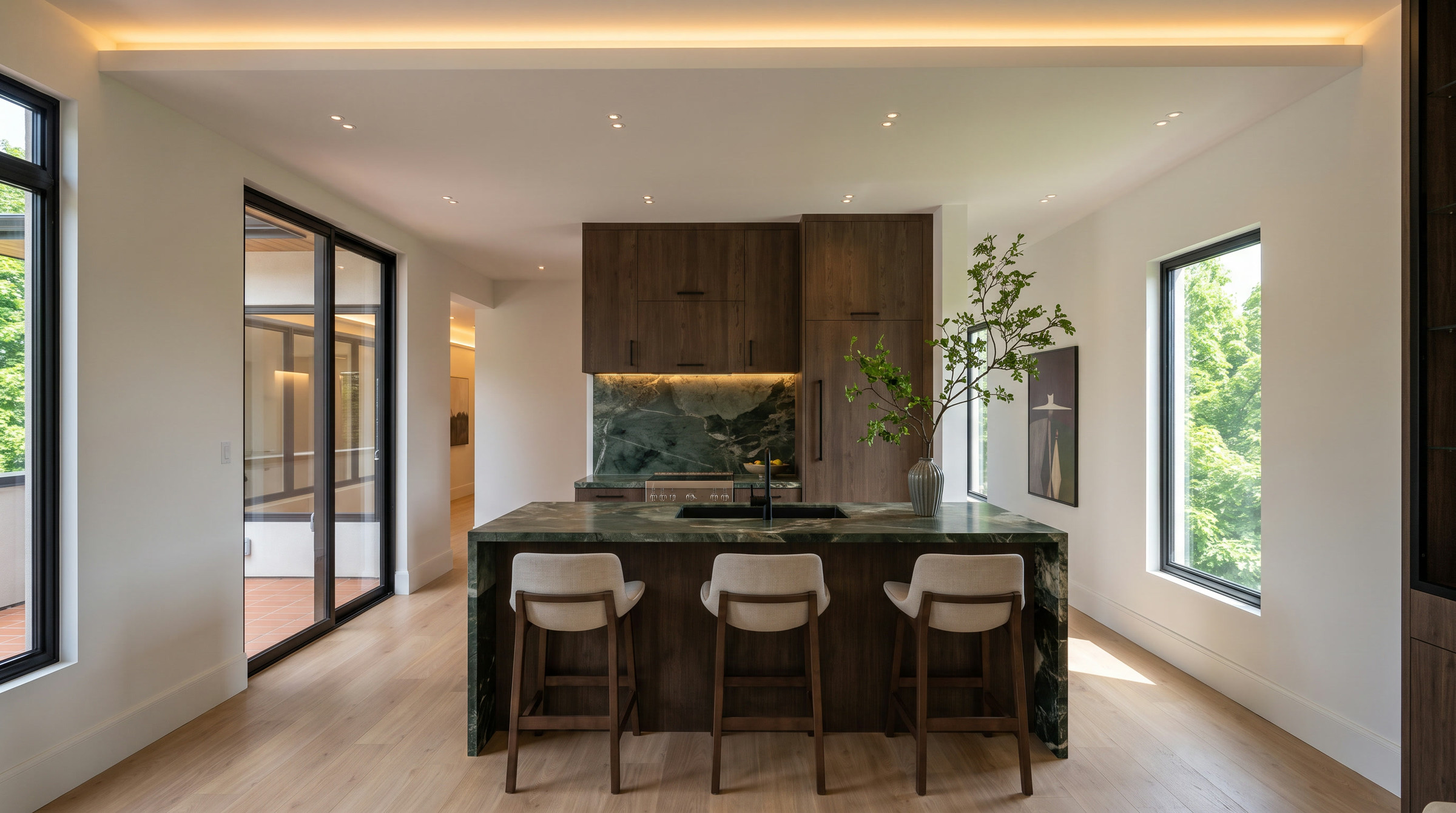
On Sixth Lane, our new build in the GTA, the kitchen and the upper living area both went to natural stone rather than engineered quartz. The upper kitchen carries a green stone counter and a matching backsplash; elsewhere in the house the palette runs to Calacatta Viola marble, white oak and travertine.
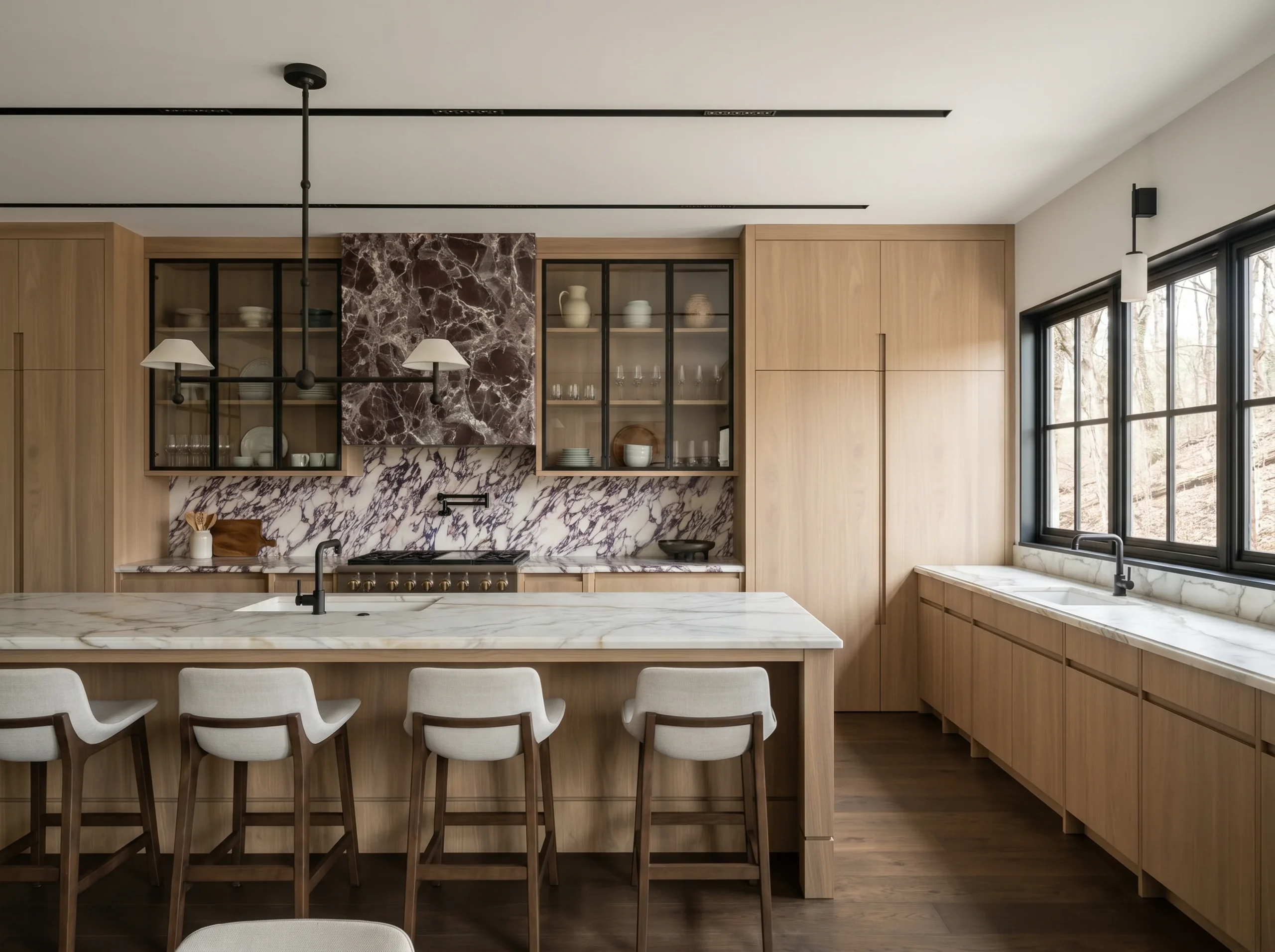
That decision was not made because natural stone is better. It was made because the room asked for it. The upper kitchen is a small, quiet space where the counter is one of very few surfaces you actually see, so the stone had to carry the room rather than sit under it. Engineered quartz can be beautiful, but its pattern is drawn to repeat — and in a room where you take in the whole run of counter at a single glance, a repeat is visible.
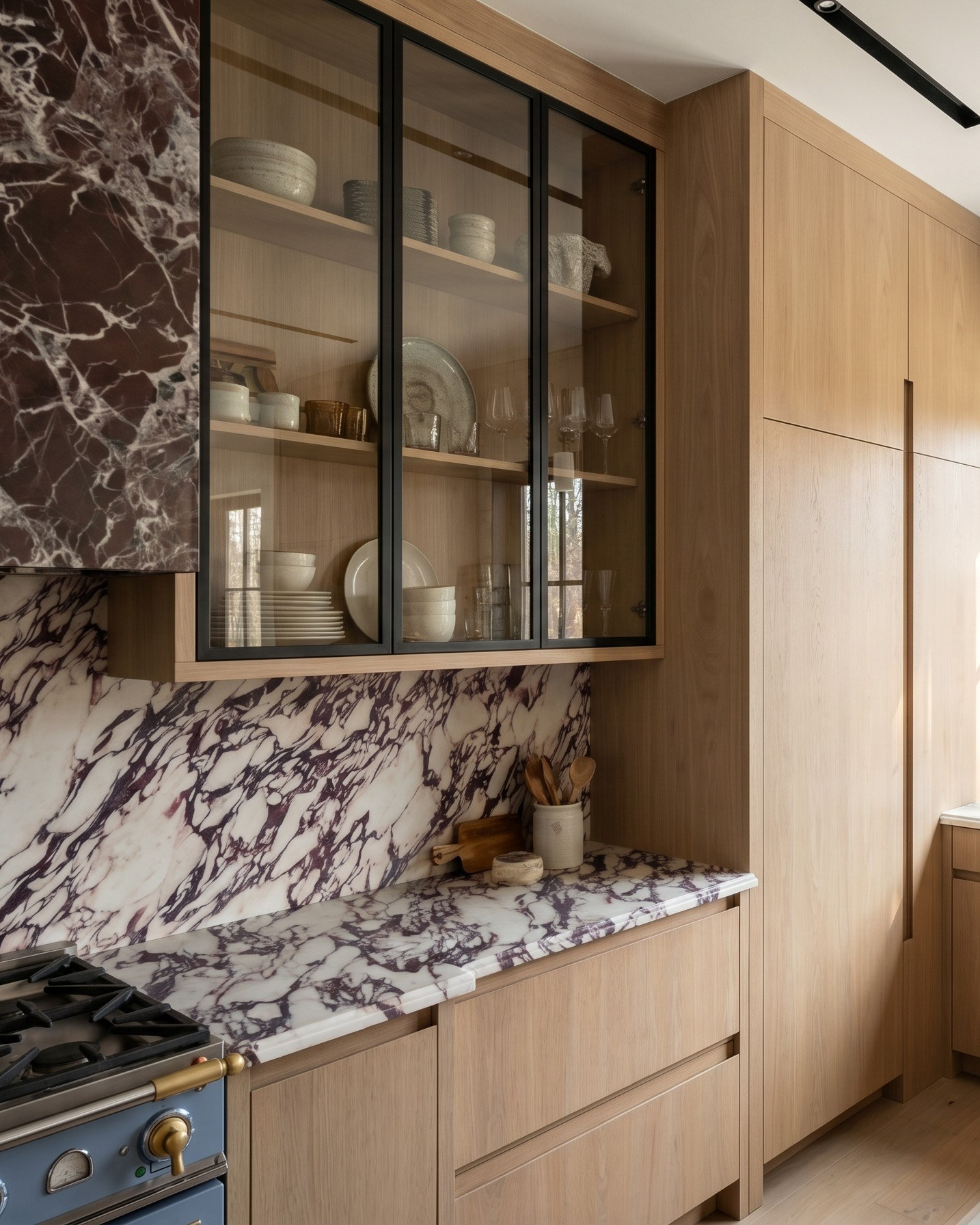
The rule we work to is simple enough to hand over: if the stone is the feature, buy the slab. If the stone is the background, buy the performance.
Cost, and the number that surprises people
Material price for the two overlaps far more than most people expect — a premium quartz and a mid-range quartzite frequently land in the same band. The cost difference tends to show up in fabrication. Quartzite is harder, so cutting, mitring and polishing it takes longer and wears tooling faster, and any waterfall end or mitred edge multiplies that. A design with three mitred returns will separate the two quotes far more than the slab price did.
The other cost nobody quotes for is the trip. Quartzite has to be selected slab by slab, at the yard, in person — you are choosing a specific piece of stone, not a product code. Budget an afternoon for it, and expect to fall for something outside your range. That is the job.
A short way to decide
- Choose quartz if you want a known quantity: consistent colour, no sealing, no maintenance, and a surface you can specify from a sample without visiting a yard.
- Choose quartzite if the counter is a feature of the room, if you want veining nobody else has, or if your kitchen genuinely sees hot pans.
- Look again if a slab is labelled quartzite but the price is unusually low — ask what it actually is before it is cut.
Whichever way it goes, make the decision before the cabinets are ordered rather than after. Counter thickness, edge profile and the position of a waterfall all touch the millwork drawings, and a stone change late in the process is one of the more expensive small revisions in a kitchen. We cover where that decision sits in the wider sequence in how long a kitchen renovation actually takes, and the way we run selections generally in our process.
Countertops are one decision inside a much longer list. If you are still shaping the whole room, the kitchen details we are specifying in 2026 covers where the stone sits alongside cabinetry, hoods and hardware.
Common questions
Is quartzite better than quartz?
Neither is better in the abstract. Quartzite handles heat far better and gives you veining no manufactured slab can reproduce; quartz never needs sealing and looks exactly like its sample. The right answer depends on whether the counter is meant to be the feature of the room or the quiet surface underneath it.
Does quartzite stain?
It can, because it is porous to varying degrees depending on the slab. Sealed on installation and resealed periodically, it holds up well to normal kitchen life. Red wine, oil and citrus left sitting on an unsealed or lapsed surface are the usual causes of a mark.
Can you put a hot pan on quartz?
No. The resin binder that makes engineered quartz non-porous is also what fails under direct heat, and scorching or discolouration from a hot pan does not polish out. Quartzite, being stone throughout, is much more forgiving — which is a genuine reason to choose it if that is how your kitchen is actually used.
Why is quartzite more expensive to install?
The slab price is often comparable. The difference is fabrication: quartzite is considerably harder, so cutting, mitring and polishing take longer and wear tooling faster. Waterfall ends and mitred edges are where the two quotes really separate.
Do I have to visit the stone yard?
For quartzite, yes. Every slab is different, so you are choosing a specific piece rather than a product code, and a photograph will not tell you how the veining runs across the length you need. For quartz you can specify confidently from a sample.
Granite has come back into the conversation while this comparison was being written, and the questions people ask about it are not the same ones they ask about quartz. We wrote that one separately: quartzite vs granite, and why everyone is suddenly asking.