
Trends · Studio Kimi Journal
Every year the trend lists arrive before the year does. Here is the shorter version — the details actually appearing in the drawings we are issuing this season, and the project each one came out of.
A trend list is usually written by somebody who has never had to order the material. We would rather write ours from the other end — from the specifications going out to fabricators this season. Read that way, 2026 looks less like a set of new ideas and more like a small number of old ones finally being done properly.
Most of what follows comes out of Sixth Lane, a home addition and interior renovation in the Greater Toronto Area we are carrying from design through a partial build. It completes in 2026, so the images here are from the design set rather than finished photography. This is the kitchen-specific view; the wider one is in our 2026 interior design trends piece.
Stone stopped being a countertop and became the room
The clearest change in our kitchen drawings is not which stone we choose but where it goes. Stone used to stop at the counter and run four inches up the wall, and the hood above it was equipment to be disguised — panelled in the cabinet oak, or plastered flat and painted out.
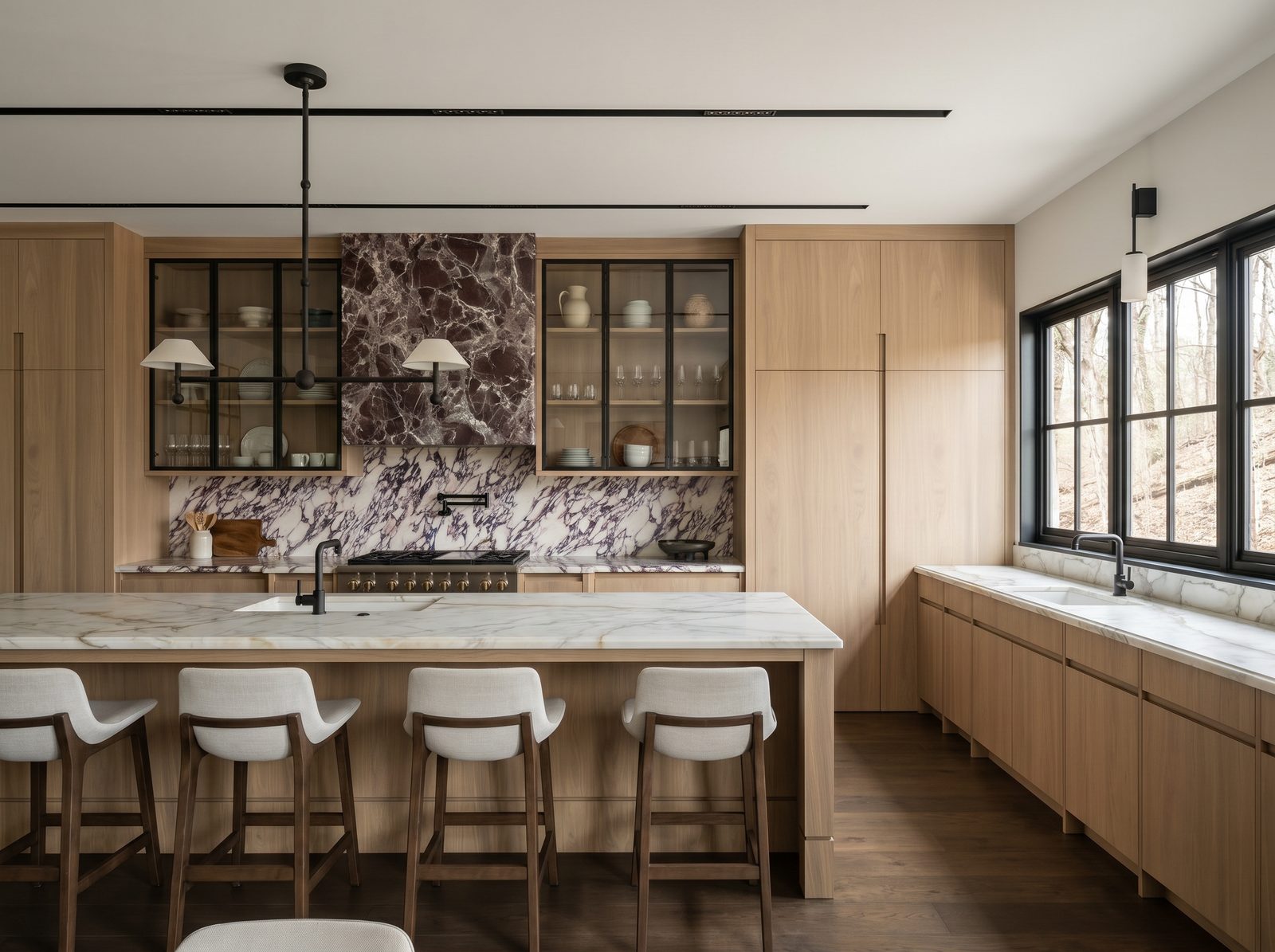
That has inverted. At Sixth Lane the range wall is a full slab of Calacatta Viola and the hood above it is wrapped in a deep rosso marble. Nothing is hidden. The working end of the kitchen is now the event of the room, and everything else is deliberately quieter so that it can be.
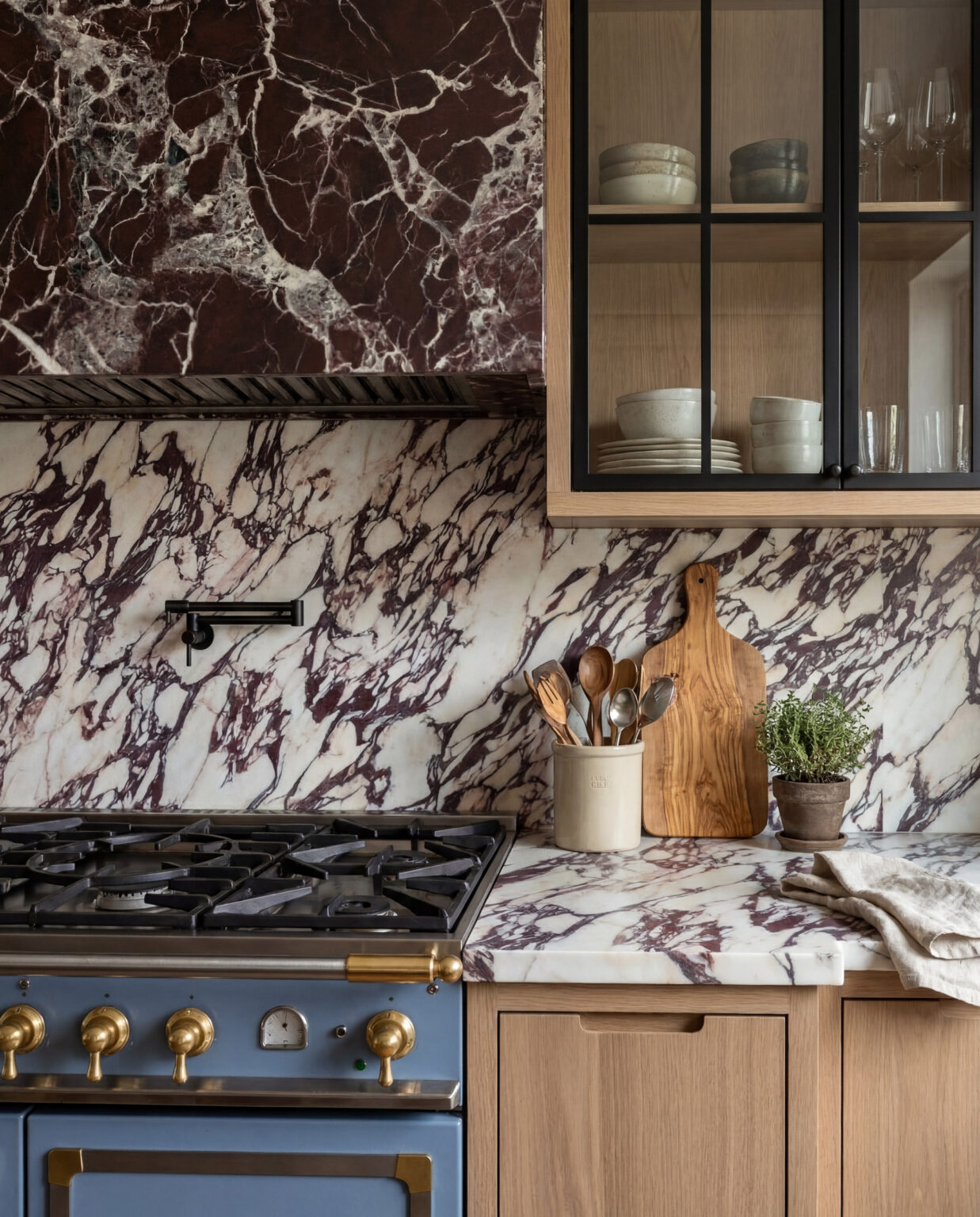
Two practical reasons it works better than it sounds. A full slab removes the horizontal joint where a backsplash meets a counter — the line that makes a kitchen look assembled rather than built. And a stone-clad hood puts vertical mass exactly where the eye already goes, so the rest of the cabinetry can stay flat without the room feeling thin. The discipline it demands is slab selection: marble with this much movement is chosen in the yard, against the real dimensions of the wall it will cover.
Fluted and reeded millwork, which is not new
Reeding appears on every 2026 list. We specified a fluted island base in charcoal and brass at Bayview Ridge in 2021, and five years on it still reads as current — which is the most useful thing anyone can tell you about a trend.
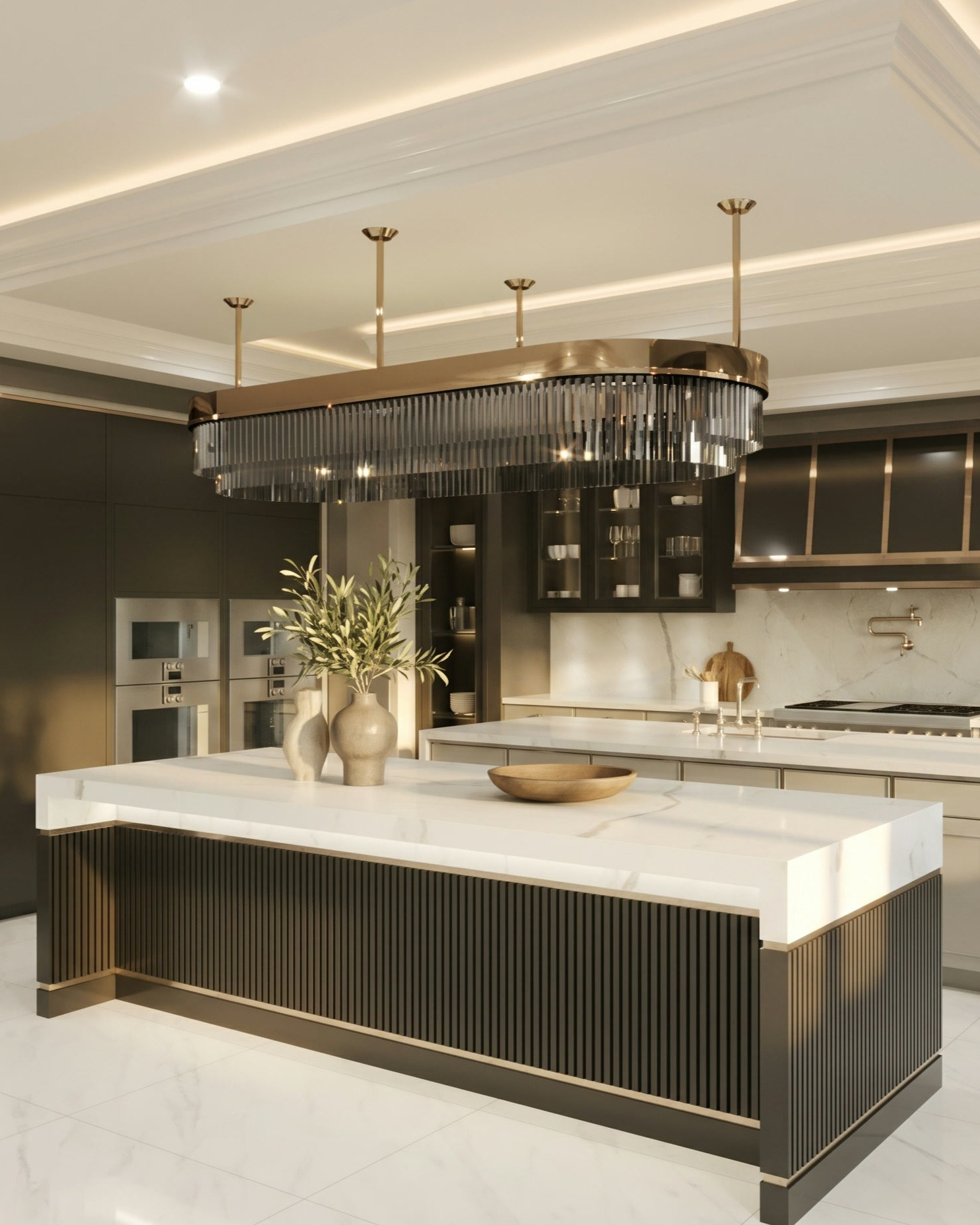
It lasts because reeding is a texture rather than a motif. A large flat cabinet face is a difficult thing in a room: it reads as a blank at a distance and shows every fingerprint up close. Vertical reeding solves both at once, catching light along its length so the surface has depth without needing a colour or a pattern to carry it. The same logic sends reeded glass through the rest of the house — at Sixth Lane it screens the ensuite shower and closes the powder room off the entry.
Where it goes wrong is quantity — reeded island, reeded pantry doors, reeded glass and a fluted tile in one room, and the texture becomes a theme, which is how a room dates.
Glass-front uppers, and the end of the sealed kitchen
The kitchen that hid everything behind identical slab doors is being reopened. Glass fronts are back in the uppers, usually in slim black or bronze frames. At Sixth Lane a pair of them flank the hood, breaking the oak run twice across the wall; at Bayview Ridge a symmetrical set frames the window and prep sink.
This is the trend that asks the most of the person living with it. A glass front commits you to what sits behind it, so we plan the relief at the same time: at Sixth Lane a full-height pantry wall runs down the working side of the kitchen, and the small appliances live there instead. Glass fronts and a generous pantry are one decision, not two.
Warm metal has replaced the all-black kitchen
Black hardware was the default for most of the last decade, and it made a great many kitchens look the same. Warm metal has taken over: brass, bronze, aged nickel, increasingly unlacquered so the finish is allowed to move rather than sealed to stay new. At Sixth Lane it sits on the range itself, brass against a deep blue body with white oak either side; at Bayview Ridge it runs as a fine gold inlay through two-tone charcoal-and-cream cabinetry.
One rule holds in both: a single warm metal per room, matched across taps, hardware and lighting. If it is unlacquered, that belongs in the conversation before it is ordered. Living brass darkens where a hand lands, and a client who was expecting it finds that beautiful. A client who was not calls it a defect.
Colour is arriving as stone, not as paint
The coloured kitchen of the last few years was a painted one — deep green or soft clay on the cabinetry, against neutral everything else. In our drawings the colour now arrives as material. The upper kitchen at Sixth Lane is built around a single slab of green stone, set against dark-stained oak and plain white walls. No accent colour appears anywhere else in that room, because the slab is not one green. It carries the scheme by itself.
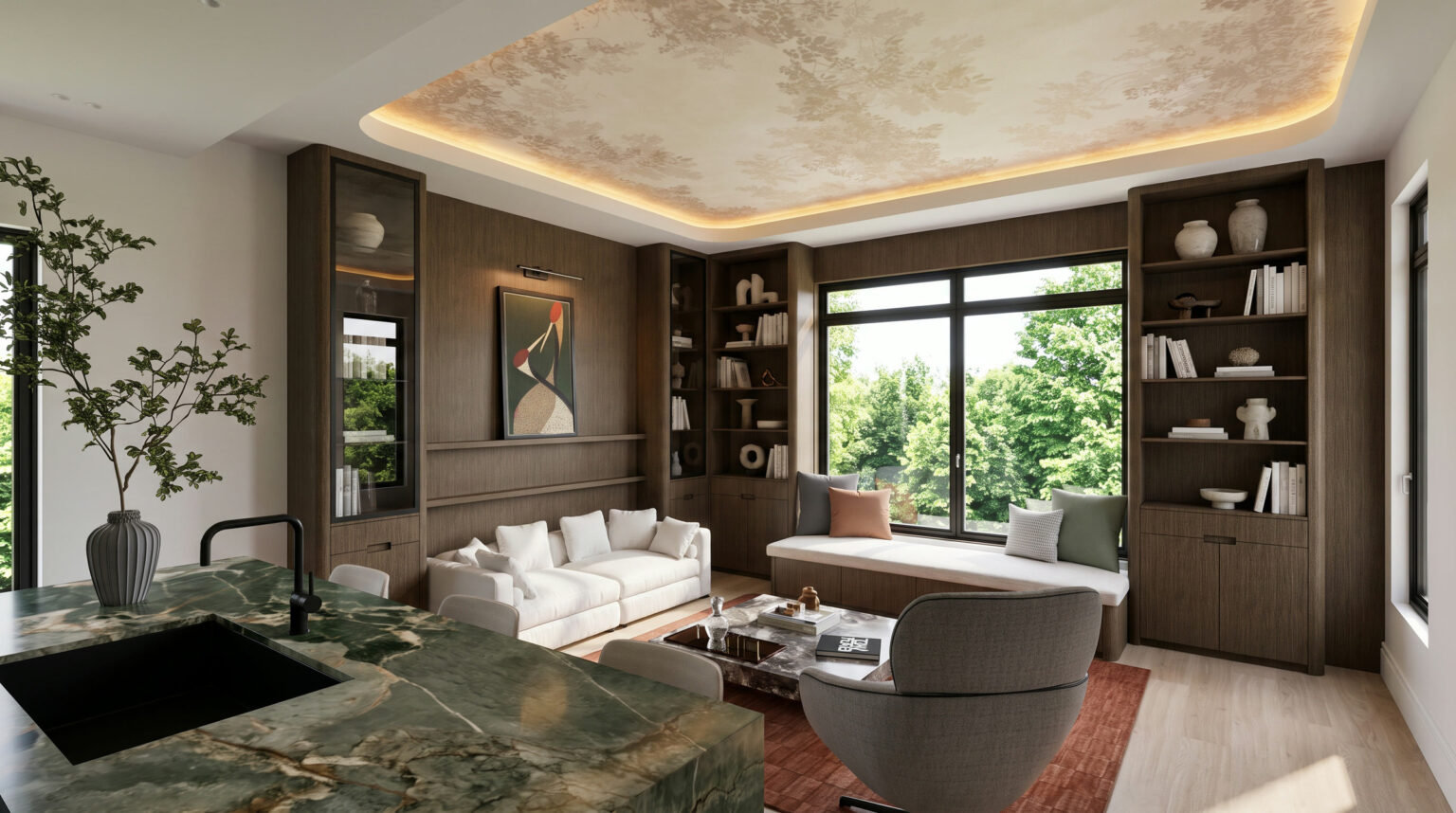
Material colour also ages differently. A wall colour is a decision you quietly re-make every few years; a stone is one you make once. And the variation across a natural slab does what an even paint film cannot — it shifts as the light moves, which is why a room built on stone rarely feels flat late in the day.
How a trend earns a place in the drawings
The test is the same every time: will it still look considered when the room is ten years old, does it survive daily use, and does it sit with the two materials already chosen for that room. Most of what appears on a January list fails at least one. The five above do not.
If you are planning a kitchen this year, sequence matters as much as selection — hood, counter and cabinetry all touch the millwork drawings, and changing one late is expensive. We set out the timing in how long a kitchen renovation actually takes, and how we run selections in our process.
Common questions
What are the kitchen trends for 2026 in Canada?
Four are showing up in almost every specification we issue: stone carried beyond the counter and onto the hood, fluted and reeded millwork used as texture rather than decoration, glass-front uppers in slim dark frames, and warm metal in place of the all-black kitchen. Under all four is a quieter shift — colour arriving as material rather than paint.
What is the biggest kitchen trend for 2026?
The stone hood. Stone used to stop at the counter and run a few inches up the wall; now it climbs the range wall and wraps the hood above it, so the working end of the kitchen becomes the event of the room rather than the part everyone tries to hide.
Are fluted and reeded cabinets going out of style?
We do not think so. Reeding is a texture rather than a motif, and textures date far more slowly than shapes. We specified a fluted island base in 2021 and it still reads as current. The way it goes wrong is quantity: one reeded element per room, against flat surfaces.
What interior design trends for 2026 apply to a kitchen?
The kitchen is where the year’s material story is easiest to see: fewer materials per room, each doing more work; natural stone with visible movement instead of even printed pattern; warm metals allowed to age; and visible storage behind glass, balanced by a pantry that absorbs everything else.
Is the all-white kitchen over?
It is no longer the automatic safe choice, which is a different thing. A white kitchen still works when the architecture around it is doing the talking. What has changed is that clients now ask what a room is made of before they ask what colour it is.
Stone is doing most of the work in the kitchens above, and the choice between the natural ones is its own decision. More on that here: quartzite vs granite.